

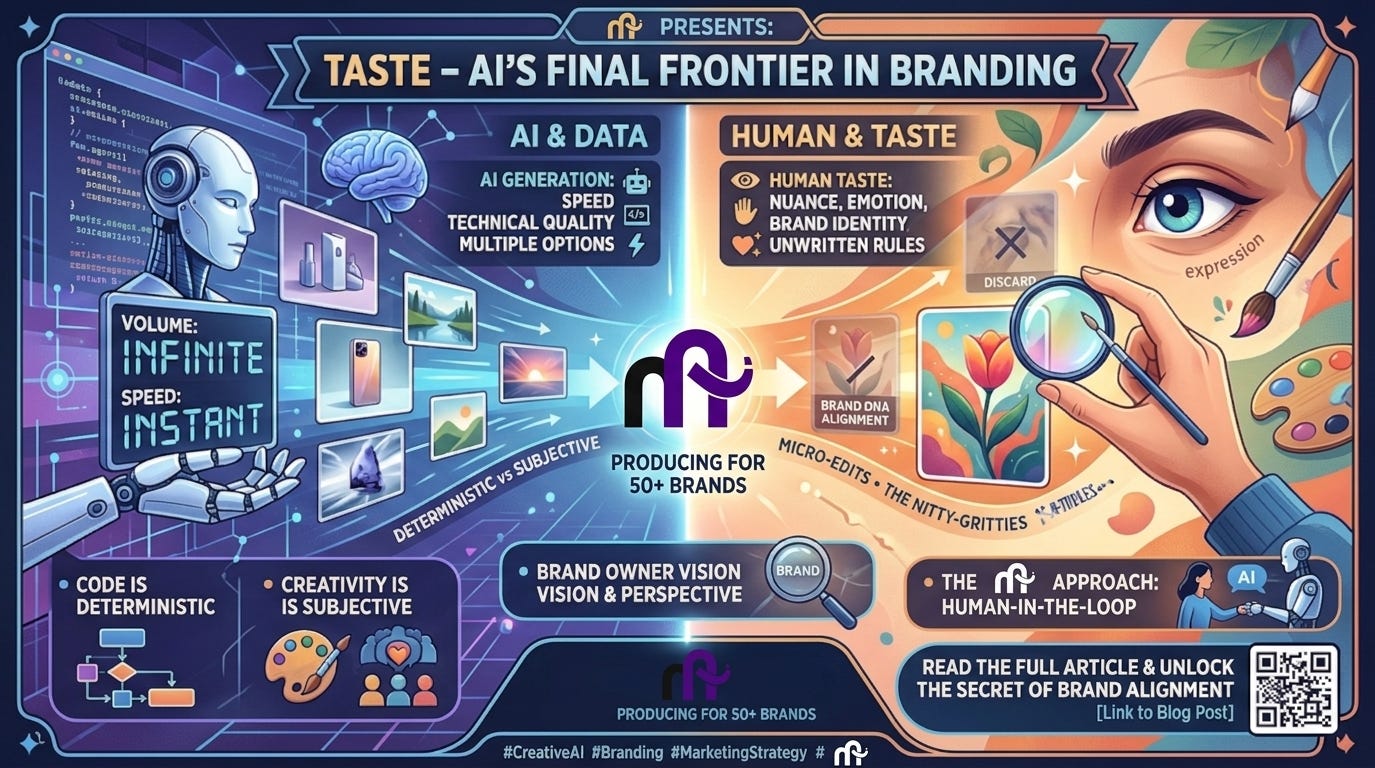
Look at any modern AI video generator or image model. The technical capability is staggering—crisp lighting, fluid motion, hyper-realistic physics. You can prompt a system and get fifty stunning visual options in seconds.
Yet, if you manage a portfolio of distinct brands, you already know the wall every AI tool runs into:
AI can generate infinite assets, but it cannot possess taste.
At Kumba, as we produce high-volume visuals and video campaigns across our 50+ brands, this reality hits us every single day. The hardest nut for AI to crack isn’t rendering speed, resolution, or prompt comprehension. It’s human judgment.
1. Creative Content vs. Coding: The Subjectivity Problem
The fundamental flaw in expecting AI to autonomously manage creative direction lies in misinterpreting what creative work actually is.
Creative content is fundamentally unlike software development.
Coding is deterministic: Code operates on logic and binary evaluation (111 or 000). Either the function compiles, passes the unit tests, and executes as expected, or it throws an error. There is an objective baseline of success.
Creative output is subjective: The exact same ad poster, illustration, or video edit can be adored by one audience segment and completely rejected by another. There is no mathematical compiler for visual impact or emotional resonance.
Because AI models are trained on statistical averages across massive datasets, they optimize for the “consensus middle.” But strong branding is never about consensus—it’s about taking a definitive visual stance.
2. The “War of the Worlds” Reality: Why AI Can’t Cross the Chasm of Taste
Why does this limitation exist in the first place? Why will it be almost impossible for AI to cross the chasm of human “taste buds”?
The answer is as fundamental as H.G. Wells’ War of the Worlds. In Wells’ story, the invaders couldn’t survive because they lacked exposure to the microscopic, organic ecosystem of Earth.
Similarly, this is our physical reality. This is the world where humans live, breathe, perceive, and pursue pleasure.
What we personify, design, and recreate in branding is deeply personal. It is shaped by a lifetime of lived experience and influenced by millions of non-verbal, non-measurable cues:
The subtle nostalgia of a specific childhood lighting condition.
The unspoken tension in a social dynamic.
The visceral tactile memory of a material texture.
AI is fundamentally cut off from this sensory reality. It does not possess body, breath, or emotion. Because it lacks access to these non-measurable cues, it cannot run permutations and combinations on attributes it cannot feel. It can analyze pixels, but it cannot experience life.
Human Taste Engine: Lived Experience  +  Sensory Perception  +  Unspoken Cues  --->  Intuitive Judgment
AI Prompt Engine:   Token Probability +  Data Patterns     +  Statistical Averages --->  Raw Render
3. The “Taste” Gap: Generative Output vs. Brand DNA
Every brand owner and marketing manager carries an implicit, highly specific vision of how their brand must be represented.
An algorithm can generate a technically flawless composition, but without living in our world, it lacks the context required to navigate subjective nuance:
Contextual Nuance: An algorithm doesn’t know why a warm, diffuse studio light feels “approachable” for one brand, but “cheap and unrefined” for another.
Micro-Pacing: In video, a 0.3-second delay on a cut can be the difference between an edit feeling intentionally cinematic or feeling clumsy.
The Unwritten Anti-Patterns: Style guides capture color hex codes and fonts, but they rarely capture the unspoken rules: “We never use harsh shadows,” or “Our visuals must feel effortless, never staged.”
Prompting gets an asset 70% to 80% of the way there. But in brand perception, that remaining 20% is where 100% of the identity lives.
4. The Kumba Reality: Human Judgment as the Final Filter
Because taste cannot be calculated like an equation, the creative workflow at Kumba isn’t a single button press. It is an active, iterative dialogue.
Even with advanced engines generating stunning raw renders across our 50+ brands, the final call always belongs to a human. There is always a detailed back-and-forth—trimming frames, tweaking color grades, refining compositions, and hashing out the visual nitty-gritties until the piece actually aligns with the brand owner’s vision.
FunctionAI EngineHuman Creative / Brand DirectorPrimary RoleScalable visual generationTaste, framing, and final judgmentOutput TypeProbabilistic options & raw rendersIntentional, brand-aligned assetsInput SourceDigital datasets & text promptsLived human experience & sensory cues
AI acts as the engine, eliminating production friction and unlocking scale. But the human acts as the director, applying the perspective and discipline required to turn raw outputs into authentic brand representation.
Curation Is the Ultimate Creative Act
As visual generators become universal commodities, high-resolution visual output will no longer be a competitive advantage. Anyone will be able to render glossy product shots or motion graphics with a single prompt.
When creation becomes effortless, judgment, vision, and taste become the ultimate differentiators.
AI will continue to accelerate how fast we produce content. But the discretion to know what to keep, what to scrap, and how a brand should truly look and feel remains strictly, permanently human.